

Table of Contents
- Start With the Right Gear for Coffee on a Boat
- How to Make Coffee With Boiling Water and a Filter
- French Press and Manual Brewing Without Electricity
- AeroPress Coffee on a Boat: Fast, Compact, and Easy to Clean
- Stovetop Brewing and Percolators on a Propane Stove
- Best Coffee Makers for Boats: Choosing Equipment for Tight Spaces
- Coffee for Fishing Trips: Water, Storage, and Safety on the Water
- Frequently Asked Questions
Last Updated: November 2, 2026
Start With the Right Gear for Coffee on a Boat
Making coffee on boat comes down to three things: a heat source, a brewing device, and a way to keep both stable while the water moves. Get those right and you can brew a good cup in a space smaller than a kitchen counter.
At Reel Good Coffee, we know most anglers want a hot, sharp cup before sunrise. Keep the gear simple, keep it secured, and keep the water hot.
What You'll Need Before You Brew
A small kit beats a big one on a boat.
- A heat source: propane stove, alcohol stove, or a 12-volt kettle
- A brewing device: French press, AeroPress, pour-over cone, or percolator
- A kettle or pot with a spout you can control
Buy gear that nests, a French press that fits inside your cook pot takes up zero extra space.
How to Make Coffee With Boiling Water and a Filter
The pour-over method makes clean, bright coffee with nothing but a cone, a filter, and hot water, the simplest path to a good cup on board, with no electricity.
Here is the ratio that works: about 15 grams of ground coffee to 250 milliliters of water. That is roughly two tablespoons per cup.
Step-by-Step Pour-Over Method
- Boil your water until it just starts to roll, then take it off the flame.
- Set the cone on your mug on a stable surface, or hold the mug steady.
- Add the filter and rinse it with hot water to remove paper taste.
- Add your grounds. Level them off, do not pack them down.
- Pour a small amount of water over the grounds and wait 30 seconds.
- Pour the rest slowly in circles, keeping the water below the rim.
- Let it drain and pull the cone off.
Total brew time lands around three minutes. The main thing to watch is stability: set the mug in a sink or deep tray so a swell cannot knock it over.
French Press and Manual Brewing Without Electricity
A French press is the best all-around choice for coffee on boat: no paper filters, no power, no moving parts. Grounds in, water in, press and pour.
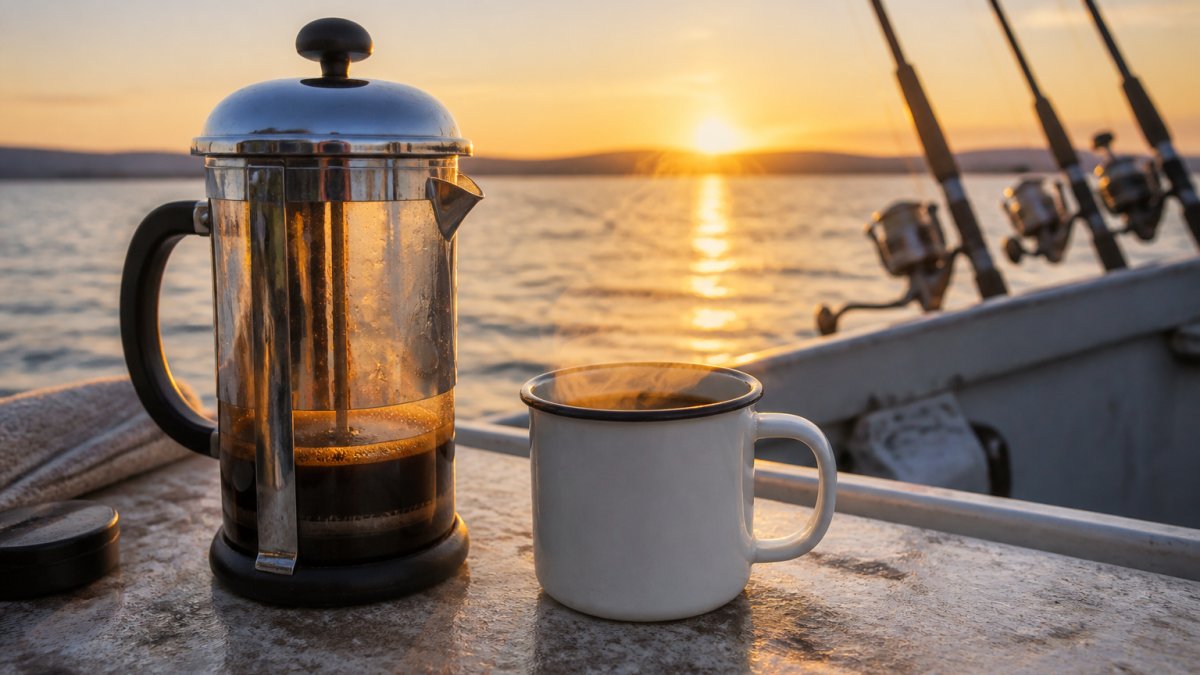
Use a coarse grind, fine grounds slip through the mesh and leave grit.
How to brew it:
- Add coarse grounds to the press
- Pour water just off the boil over them
- Stir once, then set the lid on
- Steep about four minutes, then press slowly and pour right away
Stainless models survive salt air far better than glass, which cracks, and a cracked press on day two of a trip is a bad start.
AeroPress Coffee on a Boat: Fast, Compact, and Easy to Clean
AeroPress coffee on a boat is hard to beat for speed. It brews in about 90 seconds, packs down small, and cleans up with one push of the plunger.
The trade-off is capacity: one AeroPress makes roughly one strong cup, or two smaller ones. Perfect for a solo angler; for four at dawn, it means brewing twice.
Quick AeroPress recipe:
- 15 grams of fine-medium grounds
- 200 milliliters of water, just off the boil
- Stir for 10 seconds, steep 60 seconds
Cleanup is where it wins: no sink, no filter basket to scrub. Rinse the rubber seal and you are done.
Stovetop Brewing and Percolators on a Propane Stove
A percolator is the old-school answer, and on a propane stove it still works.
How a percolator actually works: A central tube draws water up from the bottom chamber as it boils, sprays it over the grounds, and drips back down, repeating continuously.
Stovetop safety on a boat, the specifics that matter:
- Use a gimbaled stove or a gimbal-mounted pot holder. A gimbaled stove pivots with the boat's motion so the pot stays level. If your stove is fixed, a pot clamp or a fitted pot holder with a lip is the next best option. Never balance a percolator on a bare burner in a seaway.
- Match the flame to the pot base. A flame licking up the sides wastes fuel and heats the handle. If the flame is yellow or lifting off the burner, the air shutter needs adjustment or the regulator is failing.
- Turn the pot handle inward and lock it. A handle swinging out over the companionway is a burn waiting to happen. Replace a loose bail handle or wrap it with a silicone grip.
Percolator vs. French press on a moving deck: A percolator is heavier with more parts, but it stays put on a gimbaled stove and makes several cups at once. A French press is lighter and simpler but must be held or braced during the press. For three or more in choppy conditions, the percolator's stability often wins.
Fuel and storage notes: Store propane canisters upright, secured, and away from heat sources, a dedicated locker that vents overboard is standard on liveaboards.
Best Coffee Makers for Boats: Choosing Equipment for Tight Spaces
The best coffee makers for boats are the ones that pack small, clean up fast, and do not depend on shore power. Ranked by how well they suit a moving deck:
| Method | Brew Time | Space Needed | Power | Best For |
|---|---|---|---|---|
| French press | 4 min | Small | None | Solo or two people |
| AeroPress | 90 sec | Very small | None | One fast cup |
| Pour-over cone | 3 min | Very small | None | Clean, light coffee |
| Percolator | 6-8 min | Medium | None | Several people |
| Instant coffee | 1 min | None | None | Rough water, no gear |
For a crew of four or more, a percolator earns its space. For one or two, a French press plus an AeroPress covers every morning.

For the no-gear backup, our Instant Coffee comes in a resealable pouch with 30 servings, a good option to keep aboard when the wind is up and nobody wants to balance a press. Pair it with our enamel mug, 12 ounces of stainless steel with an enamel finish that shrugs off rust and staining.

Coffee for Fishing Trips: Water, Storage, and Safety on the Water
Coffee for fishing trips lives or dies on three things most guides skip: water quality, storage mechanics, and waste handling.
Water Quality: Why Tank Water Tastes Off and What to Do
Boat water tanks breed the compounds that ruin coffee. Plastic tanks leach a faint chemical taste, especially when water sits for weeks in warm weather; metal tanks pick up a metallic edge; and any tank not sanitized recently can harbor musty biofilm.
What actually affects taste:
- Chlorine and chloramine: Chlorinated water tastes flat after a few days in a tank. Chloramine is more persistent and does not dissipate with sitting. A carbon block filter removes both.
- Plasticizers: Flexible tanks and older rigid tanks can leach trace compounds. If your water smells like a new hose, that is the source.
- Biofilm and sediment: Even treated water can grow biofilm in a tank that sits. A sediment pre-filter plus periodic sanitizing (diluted bleach, then a thorough flush) is the standard routine.
Practical boat-specific recommendations:
- Filter at the tap, not just at the tank. An inline carbon filter on the galley faucet removes chlorine, chloramine, and many taste compounds before the water hits your kettle.
- Brew with the freshest water you have. If the tank has been sitting for a month, taste the water first, if it tastes off, brew with bottled water that trip.
- Do not assume bottled water is neutral. Some bottled waters are high in minerals that dull coffee flavor. Low-mineral spring water or filtered tap water is safer.
Storage: Keeping Grounds Dry in Salt Air
Salt air is the enemy of fresh coffee: humidity clumps grounds and salt residue settles into open containers. The fix is mechanical.
- Use an airtight container with a gasket, not a screw-top jar. Gaskets seal against humidity better than threads, and a hard-sided container resists crushing in a locker.
- Store whole beans if you can, and grind aboard. Whole beans stay fresh longer because less surface area is exposed to air. A hand grinder adds a step but pays off on trips longer than a few days.
- Keep the container out of the sun and away from the stove. Heat accelerates staling; a dry locker away from galley heat is ideal.
Waste: What Goes Overboard and What Does Not
Rules vary by water body, but the practical guidance is consistent: do not dump coffee grounds or paper filters over the side in marinas, anchorages, or enclosed waters.
- Coffee grounds are organic, but they float, clump, and can mat on the surface in calm water, visible pollution in a marina or crowded anchorage. Pack them out.
- Paper filters do not break down quickly in cold water and are a visual blight. A reusable metal or cloth filter eliminates the paper waste entirely.
- A small sealable bag or lidded container for used grounds is the standard solution; some boaters keep a dedicated 'grounds jar' emptied ashore.
Safety: Hot Water on a Moving Deck
- Never pour hot water while the boat is rolling. Brace against a bulkhead or the galley counter, set the mug in a sink or deep tray, then pour.
- Use a thermos to reduce reheat cycles. A quality stainless thermos holds heat for hours, one brew session instead of three, and fewer chances to spill.
- Secure the kettle. A kettle sliding off a gimbaled stove is the most common hot-water injury on boats; a pot clamp or fitted holder solves it.
- Keep a burn kit in the galley. Burn gel and sterile dressings belong within arm's reach of the stove, not in a locker across the cabin.
Frequently Asked Questions
What is the easiest way to make coffee on a boat?
The easiest route is an AeroPress or a French press paired with water heated on a propane stove. Both need no electricity, take about four minutes, and clean up with a quick rinse. If you want zero gear and zero cleanup, a quality instant coffee such as Reel Good Coffee's 30-serving pouch at $24.99 just needs hot water and a mug. Skip anything with a glass carafe on a moving deck.
Can you use an AeroPress on a boat?
Yes, and it is one of the better choices for a boat. The AeroPress is plastic, so it will not shatter if it slides off a rail, and it brews a single cup in about 90 seconds. Use a medium-fine grind, 15 grams of coffee to about 200 grams of water, and press slowly over 20 to 30 seconds. Rinse the plunger and cap, then store it dry so the rubber seal does not mildew.
How do you heat water for coffee on a boat?
A small propane or butane camp stove is the standard answer, and it heats 12 ounces of water in roughly three to four minutes. Set the stove on a flat, non-slip surface with the pot handle turned inward, and never light it below deck or in an enclosed cabin. If you have a galley stove, use that instead. An electric kettle only works if your inverter and battery bank can handle the draw, which most small boats cannot.
How should you store coffee on a boat?
Moisture and salt air ruin ground coffee faster than anything else. Keep beans whole until the morning you brew, then store them in an airtight, opaque container in a dry locker away from the engine and bilge. Pre-measure grounds into small zip bags for each day of the trip so you are not opening the main supply in spray. A 12 oz bag like Reel Good Coffee's Barracuda Bold at $24.99 fits easily in a tackle-style storage box.