

Last Updated: November 4, 2026
Quick Summary
To brew good coffee, start with freshly roasted whole beans and grind them right before brewing. Use about 1 gram of coffee for every 15 to 17 grams of water, with water heated to 195 to 205°F. Adjust the grind and ratio to suit your taste.
- Buy freshly roasted coffee, ideally roasted in small batches.
- Grind beans just before brewing, since pre-ground coffee loses flavor faster.
- Use a starting ratio of 1 gram coffee to 15-17 grams water.
- Heat water to 195-205°F, hot but not boiling.
- Pour a small amount of water first and wait 30 seconds to bloom the grounds.
Table of Contents
- Why Small-Batch Roasted Coffee Tastes Better on the Water
- What You Need to Brew Good Coffee Before a Trip
- Getting the Water to Coffee Ratio Right for a Perfect Brew
- Step-by-Step: How to Brew Good Coffee Every Time
- How to Store Coffee Beans for Freshness on Long Days Out
- Troubleshooting Bad-Tasting Coffee
- Coffee for a Cause
- Brew Your Next Cup With Reel Good Coffee
- Frequently Asked Questions
Why Small-Batch Roasted Coffee Tastes Better on the Water
Brewing good coffee on a fishing trip starts well before you reach the dock. Freshly roasted beans make the biggest difference you can control, and that matters most when your morning cup is the first thing you reach for at 4 a.m.
At Reel Good Coffee, we roast our blends freshly in small batches, built for anglers who want a rich, full-bodied cup on the water.
Watch out: Pre-ground coffee loses flavor faster than whole beans. If you can, grind right before you brew.
We recommend keeping a few simple habits in mind:
- Buy freshly roasted coffee, ideally roasted in small batches
- Store beans in a sealed container away from heat and sunlight
- Grind just before brewing, not the night before
What You Need to Brew Good Coffee Before a Trip
Packing the right gear keeps brewing simple when you are tired and cold. The list below covers the essentials, but the more useful question is which brewing method you are packing for, because the gear changes with the method.
Core gear that works for any method:
- A grinder (hand grinders pack small and need no power)
- A kettle or heat-safe pot for boiling water
- A scale that measures in grams, or a measuring scoop if you are traveling light
- A sturdy mug, like our 15oz black ceramic mug or enamel camp mug
- A thermos or 32oz insulated water bottle to keep coffee hot for hours


Method-specific gear:
- Pour-over: a cone dripper plus paper filters (or a fine metal mesh filter). Light, compact, and easy to clean, but it needs a steady pour and a little attention.
- French press: a press with a fine metal mesh filter. Forgiving, holds heat well, and brews several cups at once, but the grounds stay in contact with the water until you press, so timing matters.
- AeroPress: a compact press that brews a single strong cup quickly and is easy to rinse. A good middle ground if space is tight.
- Cold brew: a jar or bottle plus a filter. No heat needed, but it takes hours rather than minutes, so it suits an overnight setup rather than a 4 a.m. cup.
If you are packing for a weekend away, our guide on how to pack coffee gear for a weekend fishing trip walks through what to bring and what to leave at home.
Watch out: A grinder is the one item worth not leaving behind. Pre-ground coffee loses flavor faster than whole beans, so grinding right before you brew makes a bigger difference than almost any other piece of gear.
Getting the Water to Coffee Ratio Right for a Perfect Brew
A good starting point is about 1 gram of coffee for every 15 to 17 grams of water. This ratio gives a balanced cup that is neither weak nor harsh.
For a standard 12-ounce mug, that works out to roughly 22 to 25 grams of coffee and about 340 to 355 grams of water, which is close to the same amount in milliliters for water. Start there, then adjust to your taste.
Use the water-to-coffee ratio as a baseline, not a rule:
- Too weak? Use slightly more coffee.
- Too bitter? Use slightly less coffee or a shorter brew time.
- Too sour? Brew a little longer or use a finer grind.
Here is a quick reference for the starting ratio and how to adjust it for your taste.
| Item | Value | Note |
|---|---|---|
| Coffee to water ratio | 1 g coffee : 15-17 g water | Balanced starting point |
| Coffee for a 12 oz mug | 22-25 g | Adjust to taste |
| Water for a 12 oz mug | 340-355 g | Close to milliliters |
| Brewing water temperature | 195-205°F | Hot, not boiling |
| Bloom time | 30 seconds | Pour a small amount first |
Step-by-Step: How to Brew Good Coffee Every Time
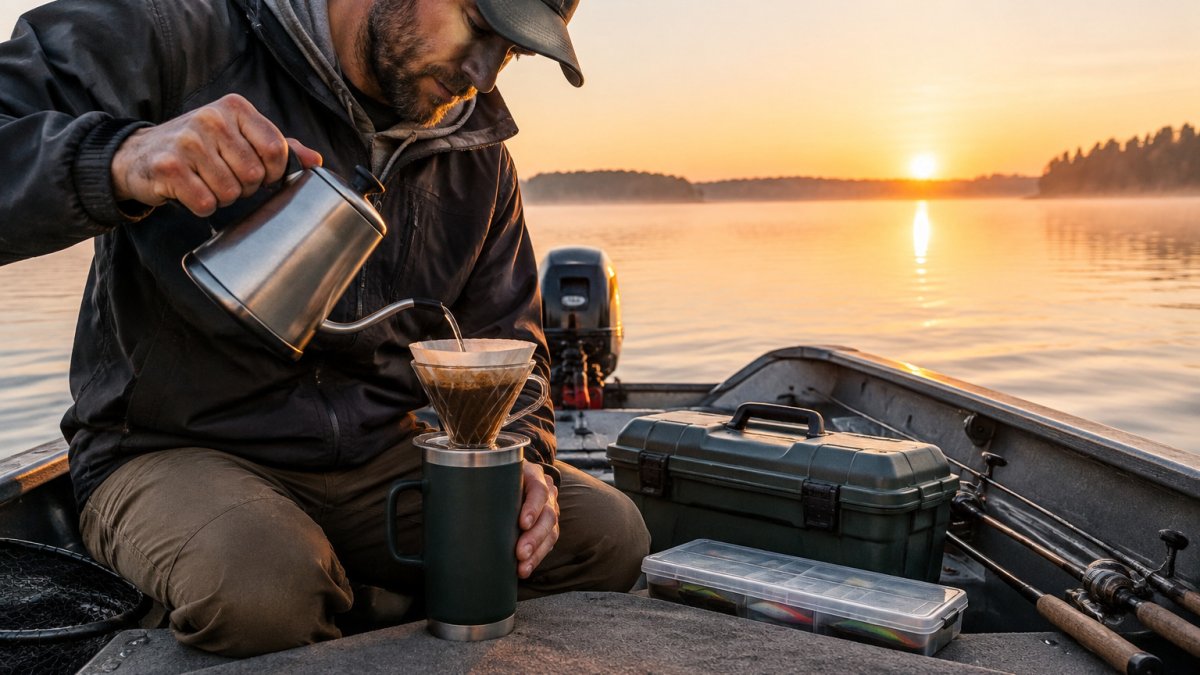
Brewing well comes down to a few repeatable steps. This method works for a pour-over or French press at camp or at home.
Reel Good Coffee Mug — 15oz Black Ceramic Coffee Cup →
- Heat your water. Bring it to a boil, then let it sit for about 30 seconds so it cools slightly.
- Measure your coffee. Weigh or scoop the amount that matches your ratio.
- Grind the beans. Use a medium-fine grind for pour-over, or a coarse grind for French press.
- Rinse your filter. Pour hot water through paper filters to remove paper taste and warm the cup.
- Add coffee and bloom. Pour a small amount of water over the grounds and wait 30 seconds.
- Pour the rest slowly. Circle the water evenly over the grounds until you reach your target amount.
- Let it drain fully. Wait until the coffee finishes dripping before you pull the filter away.
Grind Size and Water Temperature
Grind size controls how quickly water pulls flavor from the beans. Finer grinds brew faster and taste stronger, while coarser grinds brew slower and taste lighter.
Water temperature matters too. Aim for water that is hot but not boiling, which usually falls between 195°F and 205°F. Water that is too hot can make coffee taste bitter, and water that is too cool can leave it flat.
How to Store Coffee Beans for Freshness on Long Days Out
Most brewing guides stop at 'keep your beans sealed.' The practical version is more specific: what you store them in, for how long, and how storage changes the way you brew.
What breaks beans down: air, moisture, heat, and light. A sealed bag or airtight container works best, and an opaque container beats a clear one because light degrades flavor over time. Keep beans away from the stove, the sunny side of the boat, and any damp gear.
How long beans stay good: whole beans hold their flavor for a few weeks after roasting, and pre-ground coffee fades faster, often within days. That is why buying freshly roasted coffee in amounts you will use within a few weeks matters more than a 'best by' date.
Packing for a multi-day trip: bring only what you will brew in a small sealed container, and leave the rest sealed at home. Every time you open a bag, fresh air gets in, so a smaller container you refill from the main bag keeps the bulk of your coffee fresher longer.
Once brewed: coffee loses flavor as it cools. Keep brewed coffee in an insulated bottle to hold heat for longer, and drink it within a few hours for the best taste. Find out how long brewed coffee stays good outside on its own page.
Watch out: Do not store beans in the freezer unless the bag is truly airtight. Moisture from repeated thawing and refreezing is worse for flavor than room-temperature storage in a sealed container.
Troubleshooting Bad-Tasting Coffee
Most off flavors come from a few common problems. Try these fixes:
- Bitter coffee: Use less coffee, a coarser grind, or cooler water.
- Sour or weak coffee: Use more coffee, a finer grind, or let it brew a little longer.
- Papery taste: Rinse your paper filter with hot water before brewing.
- Flat coffee: Check that your beans are fresh and stored properly.
Change one variable at a time so you can tell what is making the difference.
Coffee for a Cause
We make a donation to a Veterans Service Organization, like K9s For Warriors, for every sale made.
Brew Your Next Cup With Reel Good Coffee
Our freshly roasted, small-batch blends are made for early mornings on the water. Browse our full selection of coffee and enjoy free U.S. shipping on coffee. Pair your next brew with an insulated water bottle to keep it hot all morning.
Frequently Asked Questions
What is the secret to making good coffee?
The biggest factors are fresh beans, a consistent coffee-to-water ratio, the right grind size for your brewer, and water heated to roughly 195 to 205 degrees Fahrenheit. Measure your coffee and water every time, and keep your variables steady so you can tell what changed when a cup tastes off.
How do I store coffee beans for freshness on a fishing trip?
Keep beans in an airtight container, away from heat, light, and moisture. Only grind what you need right before brewing, since ground coffee loses flavor much faster than whole beans. For multi-day trips, portion beans into a small sealed container so you are not opening the main bag every morning and letting in air. Avoid storing coffee in the refrigerator or freezer unless you can keep it sealed and bring it back to room temperature before opening.
What water to coffee ratio should I use for a perfect brew?
A common starting point is about 1 gram of coffee for every 15 to 17 grams of water, which is roughly 2 tablespoons of ground coffee per 6 ounces of water. Stronger coffee comes from using a little more coffee, and milder coffee from a little less. Adjust in small steps and write down what you used so you can repeat a cup you like.
Why does grind size matter when brewing coffee?
Grind size controls how quickly water pulls flavor out of the grounds. Fine grinds brew faster and can taste bitter if left too long, while coarse grinds brew slower and can taste weak or sour if rushed. Match the grind to your brewer: a French press needs a coarse grind, a drip machine uses medium, and espresso requires fine. If your coffee tastes harsh or thin, adjust the grind before changing anything else.